A set is a collection of distinct objects, considered as an object in its own right. Sets are one of the most fundamental concepts in mathematics. Developed at the end of the 19th century, set theory is now a ubiquitous part of mathematics, and can be used as a foundation from which nearly all of mathematics can be derived. In mathematics education, elementary topics such asVenn diagrams are taught at a young age, while more advanced concepts are taught as part of a university degree.Definition
Georg Cantor, the founder of set theory, gave the following definition of a set at the beginning of his
Beiträge zur Begründung der transfiniten Mengenlehre:
[1] A set is a gathering together into a whole of definite, distinct objects of our perception [Anschauung] and of our thought - which are called elements of the set.
The
elements or members of a set can be anything: numbers, people, letters of the alphabet, other sets, and so on. Sets are conventionally denoted with
capital letters. Sets
A and
B are equal
if and only if they have precisely the same elements.
As discussed below, the definition given above turned out to be inadequate for formal mathematics; instead, the notion of a "set" is taken as an
undefined primitive in
axiomatic set theory, and its properties are defined by the
Zermelo–Fraenkel axioms. The most basic properties are that a set "has" elements, and that two sets are equal (one and the same) if and only if they have the same elements.
[edit]Describing sets
- A is the set whose members are the first four positive integers.
- B is the set of colors of the French flag.
- C = {4, 2, 1, 3}
- D = {blue, white, red}
Unlike a
multiset, every element of a set must be unique; no two members may be identical. All
set operations preserve the property that each element of the set is unique. The order in which the elements of a set are listed is irrelevant, unlike a
sequence or
tuple. For example,
- {6, 11} = {11, 6} = {11, 11, 6, 11},
because the extensional specification means merely that each of the elements listed is a member of the set.
For sets with many elements, the enumeration of members can be abbreviated. For instance, the set of the first thousand positive integers may be specified extensionally as:
- {1, 2, 3, ..., 1000},
where the
ellipsis ("...") indicates that the list continues in the obvious way. Ellipses may also be used where sets have infinitely many members. Thus the set of positive
even numbers can be written as
{2, 4, 6, 8, ... }.The notation with braces may also be used in an intensional specification of a set. In this usage, the braces have the meaning "the set of all ...". So,
E = {playing card suits} is the set whose four members are
♠, ♦, ♥, and ♣. A more general form of this is
set-builder notation, through which, for instance, the set
F of the twenty smallest integers that are four less than
perfect squares can be denoted:
- F = {n2 − 4 : n is an integer; and 0 ≤ n ≤ 19}
In this notation, the
colon (":") means "such that", and the description can be interpreted as "
F is the set of all numbers of the form
n2 − 4, such that
n is a whole number in the range from 0 to 19 inclusive." Sometimes the
vertical bar ("|") is used instead of the colon.
One often has the choice of specifying a set intensionally or extensionally. In the examples above, for instance, A = C and B = D.
[edit]Membership
The key relation between sets is membership – when one set is an element of another. If a is a member of B, this is denoted a ∈ B, while if cis not a member of B then c ∉ B. For example, with respect to the sets A = {1,2,3,4}, B = {blue, white, red}, and F = {n2 − 4 : n is an integer; and 0 ≤ n ≤ 19} defined above,
- 4 ∈ A and 285 ∈ F; but
- 9 ∉ F and green ∉ B.
[edit]Subsets
If every member of set
A is also a member of set
B, then
A is said to be a
subset of
B, written
A ⊆
B (also pronounced
A is contained in B). Equivalently, we can write
B ⊇
A, read as
B is a superset of A,
B includes A, or
B contains A. The
relationship between sets established by ⊆ is called
inclusion or
containment.
If A is a subset of, but not equal to, B, then A is called a proper subset of B, written A ⊊ B (A is a proper subset of B) or B ⊋ A (B is a proper superset of A).
Note that the expressions A ⊂ B and B ⊃ A are used differently by different authors; some authors use them to mean the same as A ⊆ B(respectively B ⊇ A), whereas other use them to mean the same as A ⊊ B (respectively B ⊋ A).
Example:
- The set of all men is a proper subset of the set of all people.
- {1, 3} ⊊ {1, 2, 3, 4}.
- {1, 2, 3, 4} ⊆ {1, 2, 3, 4}.
The empty set is a subset of every set and every set is a subset of itself:
An obvious but useful identity, which can often be used to show that two seemingly different sets are equal:
- A = B if and only if A ⊆ B and B ⊆ A.
[edit]Power sets
The power set of a set S is the set of all subsets of S. This includes the subsets formed from all the members of S and the empty set. If a finite set S has cardinality n then the power set of S has cardinality 2n. The power set can be written as P(S).
If
S is an infinite (either
countable or
uncountable) set then the power set of
S is always uncountable. Moreover, if
S is a set, then there is never a
bijection from
S onto
P(
S). In other words, the power set of
S is always strictly "bigger" than
S.
As an example, the power set of {1, 2, 3} is {{1, 2, 3}, {1, 2}, {1, 3}, {2, 3}, {1}, {2}, {3}, ∅}. The cardinality of the original set is 3, and the cardinality of the power set is 23 = 8. This relationship is one of the reasons for the terminology power set.
[edit]Cardinality
Main article:
CardinalityThe cardinality | S | of a set S is "the number of members of S." For example, since the French flag has three colors, | B | = 3.
There is a unique set with no members and zero cardinality, which is called the
empty set (or the
null set) and is denoted by the symbol ∅ (other notations are used; see
empty set). For example, the set of all three-sided squares has zero members and thus is the empty set. Though it may seem trivial, the empty set, like the
number zero, is important in mathematics; indeed, the existence of this set is one of the fundamental concepts of
axiomatic set theory.
Some sets have
infinite cardinality. The set
N of
natural numbers, for instance, is infinite. Some infinite cardinalities are greater than others. For instance, the set of
real numbers has greater cardinality than the set of natural numbers. However, it can be shown that the cardinality of (which is to say, the number of points on) a
straight line is the same as the cardinality of any
segment of that line, of the entire
plane, and indeed of any
finite-dimensional Euclidean space.
[edit]Special sets
There are some sets which hold great mathematical importance and are referred to with such regularity that they have acquired special names and notational conventions to identify them. One of these is the empty set. Many of these sets are represented using
blackboard boldor bold typeface. Special sets of numbers include:
- P, denoting the set of all primes: P = {2, 3, 5, 7, 11, 13, 17, ...}.
- N, denoting the set of all natural numbers: N = {1, 2, 3, . . .}.
- Z, denoting the set of all integers (whether positive, negative or zero): Z = {... , −2, −1, 0, 1, 2, ...}.
- Q, denoting the set of all rational numbers (that is, the set of all proper and improper fractions): Q = {a/b : a, b ∈ Z, b ≠ 0}. For example, 1/4 ∈ Q and 11/6 ∈ Q. All integers are in this set since every integer a can be expressed as the fraction a/1 (Z ⊊ Q).
- R, denoting the set of all real numbers. This set includes all rational numbers, together with all irrational numbers (that is, numbers which cannot be rewritten as fractions, such as π, e, and √2, as well as numbers that cannot be defined).
- C, denoting the set of all complex numbers: C = {a + bi : a, b ∈ R}. For example, 1 + 2i ∈ C.
- H, denoting the set of all quaternions: H = {a + bi + cj + dk : a, b, c, d ∈ R}. For example, 1 + i + 2j − k ∈ H.
Each of the above sets of numbers has an infinite number of elements, and each can be considered to be a proper subset of the sets listed below it. The primes are used less frequently than the others outside of
number theory and related fields.
[edit]Basic operations
There are several fundamental operations for constructing new sets from given sets.
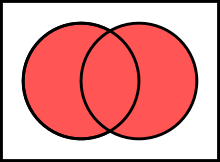
The union of A and B, denoted A ∪ B
Two sets can be "added" together. The union of A and B, denoted by A ∪ B, is the set of all things which are members of either A or B.
Examples:
- {1, 2} ∪ {red, white} ={1, 2, red, white}.
- {1, 2, green} ∪ {red, white, green} ={1, 2, red, white, green}.
- {1, 2} ∪ {1, 2} = {1, 2}.
Some basic properties of unions:
- A ∪ B = B ∪ A.
- A ∪ (B ∪ C) = (A ∪ B) ∪ C.
- A ⊆ (A ∪ B).
- A ∪ A = A.
- A ∪ ∅ = A.
- A ⊆ B if and only if A ∪ B = B.
[edit]Intersections
A new set can also be constructed by determining which members two sets have "in common". The intersection of A and B, denoted byA ∩ B, is the set of all things which are members of both A and B. If A ∩ B = ∅, then A and B are said to be disjoint.

The intersection of A and B, denotedA ∩ B.
Examples:
- {1, 2} ∩ {red, white} = ∅.
- {1, 2, green} ∩ {red, white, green} = {green}.
- {1, 2} ∩ {1, 2} = {1, 2}.
Some basic properties of intersections:
- A ∩ B = B ∩ A.
- A ∩ (B ∩ C) = (A ∩ B) ∩ C.
- A ∩ B ⊆ A.
- A ∩ A = A.
- A ∩ ∅ = ∅.
- A ⊆ B if and only if A ∩ B = A.
[edit]Complements

The relative complement
of B in A
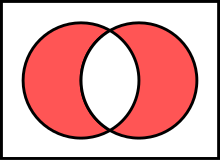
The symmetric difference of A and B
Two sets can also be "subtracted". The relative complement of B in A (also called the set-theoretic difference of A and B), denoted by A \ B (or A − B), is the set of all elements which are members of A but not members of B. Note that it is valid to "subtract" members of a set that are not in the set, such as removing the element green from the set {1, 2, 3}; doing so has no effect.
In certain settings all sets under discussion are considered to be subsets of a given
universal setU. In such cases,
U \ A is called the
absolute complement or simply
complement of
A, and is denoted by
A′.
Examples:
- {1, 2} \ {red, white} = {1, 2}.
- {1, 2, green} \ {red, white, green} = {1, 2}.
- {1, 2} \ {1, 2} = ∅.
- {1, 2, 3, 4} \ {1, 3} = {2, 4}.
- If U is the set of integers, E is the set of even integers, and O is the set of odd integers, then E′ = O.
Some basic properties of complements:
- A \ B ≠ B \ A.
- A ∪ A′ = U.
- A ∩ A′ = ∅.
- (A′)′ = A.
- A \ A = ∅.
- U′ = ∅ and ∅′ = U.
- A \ B = A ∩ B′.

For example, the symmetric difference of {7,8,9,10} and {9,10,11,12} is the set {7,8,11,12}.
[edit]Cartesian product
A new set can be constructed by associating every element of one set with every element of another set. The
Cartesian product of two sets
A and
B, denoted by
A ×
B is the set of all
ordered pairs (
a,
b) such that
a is a member of
A and
b is a member of
B.
Examples:
- {1, 2} × {red, white} = {(1, red), (1, white), (2, red), (2, white)}.
- {1, 2, green} × {red, white, green} = {(1, red), (1, white), (1, green), (2, red), (2, white), (2, green), (green, red), (green, white), (green, green)}.
- {1, 2} × {1, 2} = {(1, 1), (1, 2), (2, 1), (2, 2)}.
Some basic properties of cartesian products:
- A × ∅ = ∅.
- A × (B ∪ C) = (A × B) ∪ (A × C).
- (A ∪ B) × C = (A × C) ∪ (B × C).
Let A and B be finite sets. Then
- | A × B | = | B × A | = | A | × | B |.


